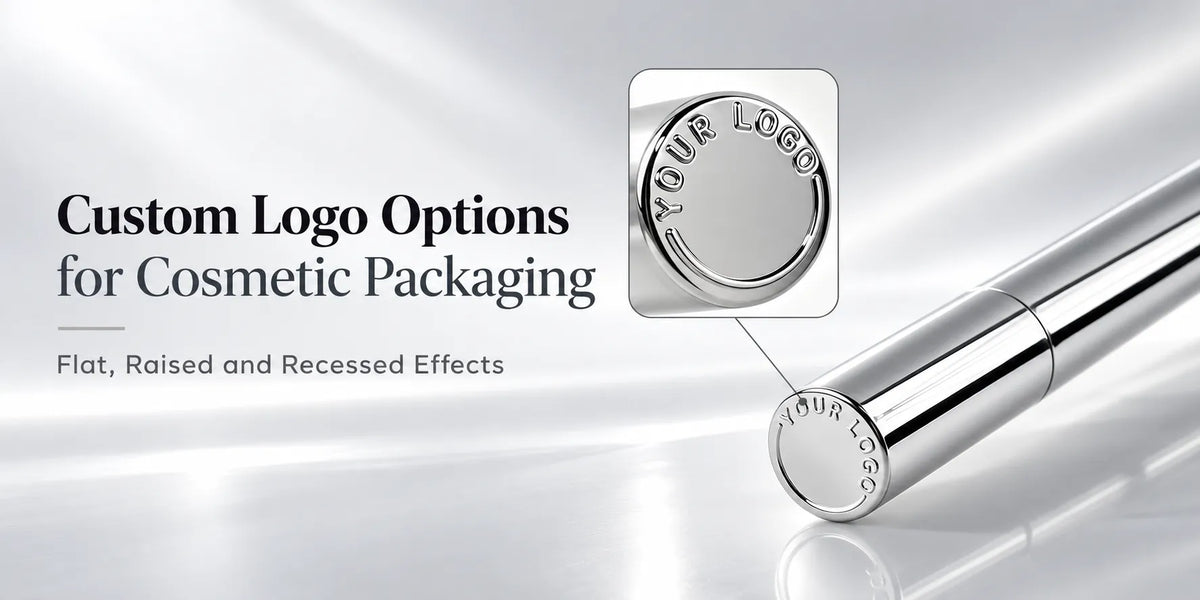
Custom logo options for cosmetic packaging should be chosen by the effect the brand wants the customer to see and feel. A flat ink logo, reflective foil mark, engraved detail, raised badge and molded relief can carry the same artwork, yet each creates a different relationship with the package surface.
The practical decision is whether the logo should remain a surface decoration, become an attached tactile element, or be formed as part of the molded component. That choice changes the usable artwork, compatible materials, sampling route and level of tooling involved. This guide compares the main effects and explains why replaceable mold inserts are available only on specially prepared molds.
Quick overview:
- Flat color: silk screen printing creates clean solid-color logos without changing the molded shape.
- Flat metallic effect: hot stamping adds a thin reflective foil detail rather than a true molded relief.
- Material-led mark: laser engraving can expose or alter a surface, but the visible depth depends on the material and process route.
- Attached dimension: metal badges and raised transfer labels add a separate tactile layer to the component.
- Molded dimension: a raised or recessed logo is formed in the component and requires compatible tooling.
- Tooling boundary: a replaceable logo insert works only when the mold was designed with a suitable insert position or has been specifically approved for modification.
1. Flat Logo Finishes Keep the Branding on the Surface
Flat logo finishes change color, contrast or reflectivity without changing the molded geometry of the cosmetic container. They are usually the most direct route when an existing package already provides a suitable decoration area and the brand does not need the logo to become a structural feature.
Silk screen printing and hot stamping are the two clearest starting options. Both leave the established package shape unchanged, but they do not create the same result: screen printing is led by ink color and opacity, while hot stamping is led by foil reflection. The material, surface finish, curvature and artwork still need to be sampled before either process is approved.
Flat Logo Option 1: Silk Screen Printing
Silk screen printing is a practical route for a logo that should read through color rather than physical depth. It works well for solid-color wordmarks, icons, product names and selected graphic blocks. Although the cured ink forms a thin layer, the finished logo is normally perceived as a flat surface treatment rather than a sculpted feature.

The result depends on ink opacity, color contrast, edge definition and the relationship between the artwork and the component. A clear lip gloss bottle may use a small white logo while allowing the formula to remain visible. An opaque mascara tube may use a stronger contrasting color. Each additional print color introduces another screen and registration step, so a visually simple logo is generally easier to reproduce consistently across several container shapes.
Screen printing can often be added to an existing package model when the material, finish, curvature and available printing area are suitable. It does not make the established body shape, dimensions or structure exclusive to the brand, but it can create a clear brand identity without opening a new mold.
Flat Logo Option 2: Hot Stamping
Hot stamping transfers a thin foil layer to the packaging surface. Gold, silver, rose-gold, champagne and selected holographic or colored directions can make a small logo appear brighter and more prominent than ordinary printed ink. The effect comes from reflection and foil character rather than from substantial physical height.

This route is useful when the logo should become a controlled luxury accent while the base color remains visible. Flat or gently curved areas usually provide the clearest transfer. Strong compound curves, deep recesses, sharp changes in level and very fine lettering require closer feasibility review because the die, foil and surface must make consistent contact.
A hot-stamped logo should not automatically be described as embossed. Foil transfer and molded or mechanically formed relief are separate effects. A brand wanting both metallic reflection and noticeable depth may need a raised badge, a formed label, or a specially developed molded structure instead.
2. Raised, Recessed, and Tactile Logo Effects Add Physical Dimension
Dimensional logo effects change how the package feels as well as how it looks. The depth may come from a surface being selectively removed, a badge or transfer being attached above the surface, or the logo geometry being formed directly during molding. These routes should be separated because they create different edges, materials, production steps and tooling requirements.
Laser engraving, metal badges and raised transfer labels can often be evaluated after the main component has already been molded. Replaceable mold inserts and direct mold modification operate at the tooling level and form the logo in every newly molded component. That distinction determines whether the project is a decoration job, an added-component assembly or a mold-development decision.
Dimensional Logo Option 1: Laser Engraving
Laser engraving can produce a precise, material-led logo without adding a separate ink color or foil. On a coated, metallized or anodized surface, the laser may remove or alter the upper finish to reveal a contrasting layer. On another compatible material, it may mark or engrave the substrate itself.
These routes do not create one universal tactile result. Some laser marks are mainly visual and have very little detectable depth; others create a shallow recess that can be seen and felt. The substrate, surface stack, color contrast, artwork scale and laser response must be sampled before the buyer describes the result as engraved, recessed or three-dimensional.

Laser engraving is strongest for fine logos, restrained lines, small symbols or product references where precise contrast matters more than full-color decoration. The dedicated guide to evaluating laser engraving on makeup packaging explains the surface and artwork checks in greater depth.
Dimensional Logo Option 2: Metal Logo Badges
A metal logo badge is a separately produced emblem attached to the package. It can combine raised and recessed detail, plating, color and a defined edge, creating a jewelry-like focal point on a compact lid, jar cap or another surface with enough support. Because the badge is a real added component, its material and touch remain distinct from the plastic or coated shell beneath it.

The package needs a suitable attachment area. A broad flat surface is the simplest starting point, while a shallow locating recess can help control position and reduce the exposed edge. The project must confirm badge thickness, weight, attachment method, alignment, edge condition and resistance to handling. Packing also matters because protruding details can rub against neighboring units or protective trays.
This route can create more dimension without changing the main package mold, but it adds badge production, application and inspection to the assembly flow. It should therefore be judged as a component decision rather than only as a logo-printing charge.
Dimensional Logo Option 3: Raised Transfer Labels
A raised transfer label places a separately produced tactile logo layer onto the component. Depending on the confirmed construction, it can support several colors, fine graphic detail, gloss or a softly domed surface. It gives the eye and fingertip more information than a standard flat print while avoiding a change to the package's primary mold.

The exact label build and application method must be specified because “raised transfer” can describe different films, inks, resins and adhesive systems. The sample should confirm edge visibility, height, color, alignment, bonding and performance on the actual substrate and finish. Tight curves, textured surfaces, seams and high-friction grip areas can reduce the usable application zone.
A raised transfer remains an attached layer rather than part of the molded wall. This distinction matters when the brand wants a seamless material-integrated logo, when the package will experience repeated rubbing, or when the added layer affects the intended material and recycling description.
Dimensional Logo Option 4: Replaceable Mold Inserts
A replaceable mold insert is a removable tooling element positioned inside the injection mold. The insert carries the logo geometry, and molten plastic reproduces that geometry during molding. The insert stays in the tool; it is not inserted into the finished package and should not be confused with insert molding or an attached logo badge.
When a compatible mold platform already has a reserved logo-insert position, a brand-specific insert can be machined for that defined area. A later logo change may then be handled by producing another insert rather than rebuilding the complete cavity surface. This can reduce the scope of a branding change, while the package shape, capacity, closure and mechanism remain the same.

Selected newer KAIYA mold platforms include this type of reserved position, but availability is model-specific. The permitted logo size, shape, location and relief direction are controlled by the existing insert area. A wordmark cannot automatically extend beyond that boundary or move to another component without a separate tooling review.
For a multi-cavity mold, the production plan must also account for a matched logo insert in each active cavity. The trial sample should be checked for relief clarity, gloss or texture differences, insert outline, cavity-to-cavity consistency and any effect on demolding.
Why this option is not available on every mold?
A mold needs more than an empty-looking space on the package surface. A replaceable insert requires a correctly engineered pocket, secure retention, sufficient surrounding steel and a surface that can remain aligned after repeated molding cycles. The location must also work with the gate, cooling channels, vents, ejector system, parting direction and visible finish.
An existing mold with a continuous polished cavity surface may have no reserved insert pocket. Cutting one into the tool can affect surface continuity, strength, cooling, sealing or the appearance of the molded component. A visible insert boundary or texture mismatch may also appear if the fit and finishing are not controlled. Retrofitting can be evaluated by the mold engineer, but it is not a standard option that should be promised for every existing model.
Best starting point: ask whether the exact mold number includes a confirmed replaceable logo area before designing the artwork around this route. If it does not, compare printing, hot stamping, laser engraving, an attached badge or label, direct mold modification and new tooling rather than assuming the insert can be added later.
Dimensional Logo Option 5: Direct Mold Modification or Original Tooling
If an existing mold has no reserved insert system, a molded logo may require direct work on the cavity or core, replacement of a larger tooling section, or development of a new mold for the visible component. The feasible route depends on the tool construction, available steel, logo position, required relief and condition of the existing surface. Some changes remove tool steel; reversing them or changing to another logo later may require welding, a larger replacement insert or a rebuilt component tool.

Multi-part cosmetic packaging should be assessed component by component. In a double-wall cap or lipstick shell, the visible outer part may use a separate mold from the inner functional component. A logo change may therefore involve only the outer-component tool. In a single-piece part, or where the logo crosses a functional wall, the tooling impact can be broader.
For an original package, the strongest route is to include the logo zone during custom cosmetic packaging development. The design team can decide whether to machine a fixed logo directly into the mold or reserve a replaceable insert area for future brand or artwork versions before the tool is cut.
How raised and recessed molded logos are formed
A raised logo on the plastic part is created by corresponding recessed geometry in the mold surface or logo insert. A recessed logo on the part requires projecting tool geometry. This mirror relationship is easy to overlook when a two-dimensional artwork is converted into a three-dimensional molded feature.
Stroke width, relief depth, draft, spacing, corners and demolding direction all matter. Fine script, narrow gaps or deep vertical walls can become difficult to fill, polish or release cleanly. A raised mark is often easier to read at small scale, while a recessed mark can create a quieter result and protect the lowest part of the detail from direct rubbing. The final choice should follow the package surface, logo proportions and mold engineer's DFM review rather than a generic preference.
Molded relief uses the component's own material color unless another decoration step is added. Contrast therefore comes from shadow, highlight, texture and viewing angle. A shallow logo can look refined under directional light but almost disappear when its color and gloss match the surrounding surface, so trial parts should be reviewed under realistic lighting.
3. Match the Logo Route to the Brand Effect
| Desired Impression | Useful Starting Route | Main Control Point |
|---|---|---|
| Clean and Graphic | Silk screen or pad printing | Color opacity, edge clarity and placement |
| Bright Metallic Accent | Hot stamping | Foil character, transfer continuity and curvature |
| Precise Material-Led Detail | Laser engraving | Surface response, contrast and actual depth |
| Jewelry-Like Focal Point | Metal logo badge | Attachment, edge, thickness and packing protection |
| Colorful Tactile Detail | Raised transfer label | Layer construction, adhesion and surface geometry |
The strongest logo is not necessarily the deepest or most reflective. A small black screen-printed mark can suit a clean treatment-led jar, while a compact lid may benefit from a metal badge and a lipstick cap may carry a restrained molded monogram. The package shape, color, finish and logo should create one visual hierarchy rather than compete for attention.
4. Approve the Logo Route with KAIYA before Production
KAIYA can begin with the selected container, vector artwork, intended logo size, preferred position, target color or tactile effect, component material, surface finish, quantity and reference image. The team can then separate what is possible through an existing-mold decoration route from what requires an attached component, compatible replaceable insert, direct mold work or original tooling.
For a surface logo, approval should record the artwork version, color or foil, process, position, orientation, base finish and decorated sample. For an attached logo, it should also record thickness, attachment method and alignment. For molded relief, the approved 3D definition, insert or cavity reference, relief direction, trial part and active mold cavities become part of the production standard.
KAIYA supports suitable projects through artwork adaptation, cosmetic packaging surface treatments, decorated samples, structural design, DFM, prototyping, tooling and mold trials. Clear separation between surface decoration and tooling-led customization allows the brand to choose the effect it wants without underestimating the development route required to produce it.