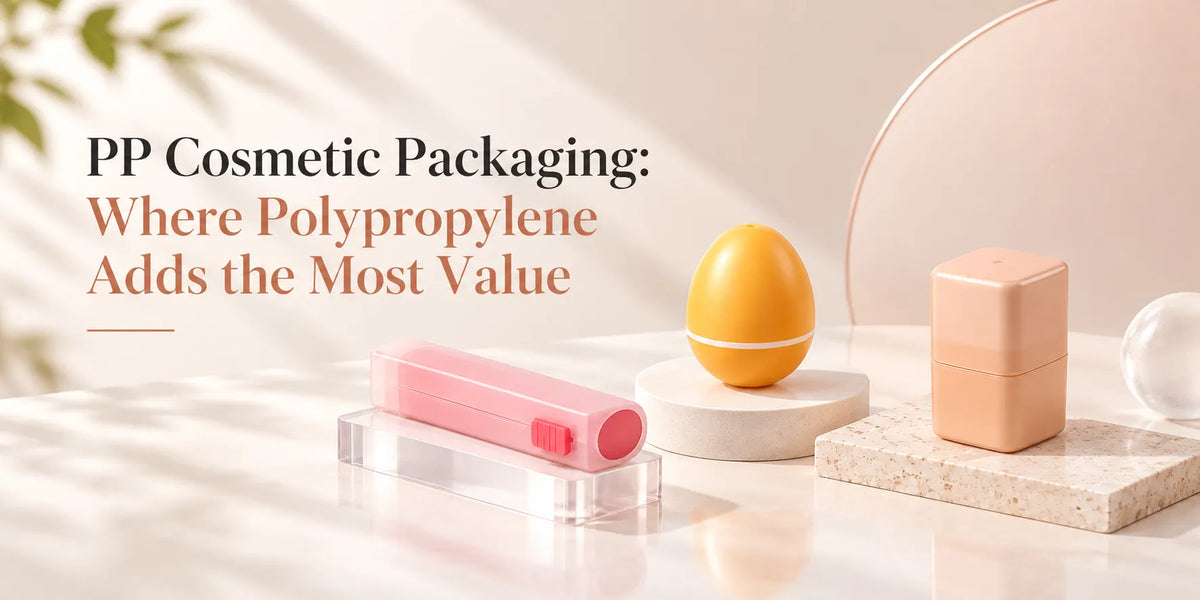
PP cosmetic packaging is not one fixed type of container. Polypropylene may form the visible jar or compact, or it may work inside a package as a cap, sifter, inner cover, support part, snap feature or hinge. Its value comes from matching the material's low weight, moldability and controlled flexibility to the job of each component.
This guide explains how PP is used across color-cosmetic packaging, why different PP grades produce different results, and what buyers should review in structure, appearance, decoration and formula contact. Pure PP packaging is included as one possible construction, not as the only way to use the material.

Quick overview:
- Component role: PP may be the main container material or one functional part within a mixed-material assembly.
- Grade selection: stiffness, impact behavior, clarity, flow and hinge performance vary across PP families and commercial grades.
- Package feel: low weight and moderate flexibility can support practical designs, but geometry must prevent unwanted flex or warpage.
- Appearance: molded color and soft translucency are natural strengths; thick glass-like clarity requires a different visual route.
- Process control: printing, coating, bonding and formula contact must be approved on the actual molded component.
1. PP Is a Functional Packaging Material, Not One Visual Style
Polypropylene is a low-density thermoplastic used in injection-molded and selected blow-molded packaging parts. Depending on the resin grade and component design, it can provide useful stiffness, toughness, chemical resistance, flex and repeated movement. These characteristics make PP relevant when a cosmetic part must do more than provide an outer appearance.
The same material family can create an opaque colored cap, a translucent jar, a flexible snap or a thin living hinge, but those results do not come from the letters “PP” alone. Buyers should define the component's function first and then approve the commercial grade, mold design and processing route that produce the required behavior. KAIYA's wider cosmetic packaging materials selection follows this component-level logic.
2. One Package Can Use PP in Several Different Roles
A multi-part cosmetic container rarely asks every component to behave identically. The visible shell may need strong rigidity or optical depth, while an inner insert may need controlled flex. PP can therefore be used as the primary body material, a closure material or a functional internal material according to the package.
| PP Component | PP Role | Buyer Check |
|---|---|---|
| Body / Lid | Lightweight structure | Rigidity, warpage, fit |
| Cap / Closure | Threads and flex | Opening, leakage, cycle |
| Plug / Sifter | Flexible molded fit | Contact, insertion, removal |
| Hinge / Flap | One-piece movement | Thickness, flex life |
| Internal Support | Positioning support | Stability, compatibility |
Important distinction: a package containing PP is not necessarily a PP container, and a PP container is not necessarily entirely PP. Accurate material communication begins with a bill of materials for the commercial component set.
3. PP Applications Change with the Cosmetic Category
Jars and pots are a natural application when the project needs a light body, molded threads and direct product access. PP may be used for the jar, lid and selected inner cover in balm, lip-care, cream or treatment-led formats. The opening, depth, seal and formula contact still need to be matched through the selected cosmetic jar packaging model.
For a loose powder container, PP can be relevant to the sifter, inner cover, reservoir or cap. Here the buyer should focus on powder flow, sifter-hole pattern, dust migration, lid fit and travel behavior. The material matters, but dispensing control is what determines whether the package feels clean in use.
Selected cosmetic compact cases may use PP for the case, base, tray, hinge or closure features. A one-piece living hinge can simplify the construction, while other models use separate pins, mirrors, metal pans or magnets. Stick and lipstick packages may also use PP in selected cups, caps or internal supports, but the full mechanism must be confirmed part by part.

4. Homopolymer, Random Copolymer and Impact Copolymer Are Not Interchangeable
PP is a material family with several grade directions. A homopolymer is commonly considered when stiffness and heat performance are important. A random copolymer can improve optical appearance and provide a different stiffness-impact balance. An impact copolymer is selected when toughness has greater priority, although its appearance is usually less clarity-led.
These names provide an engineering starting point rather than a final packaging specification. Melt flow, additives, nucleation, colorant and the supplier's exact grade change molding and finished-part behavior. The factory and mold maker should evaluate the grade against the part geometry, required surface, closure movement and production process before it becomes the approved resin.
5. Lightweight and Slightly Softer Feel Need Structural Control
PP commonly creates a lighter and less rigid tactile impression than an ABS outer shell or a thick PETG wall. That character can work well for practical, friendly, minimal or travel-oriented packaging. It can also reduce handling and shipping weight when the structure is designed efficiently.
The final feel depends on wall thickness, ribs, curves, part size and assembly support. Broad flat surfaces may flex or show warpage more readily if they are not reinforced correctly. A rounded profile, controlled wall transitions and well-positioned structural details can make the package feel intentionally light rather than weak.
6. PP Supports Molded Color and Controlled Translucency
Molded color is one of the clearest ways to build a PP package. White, black, pastel, vivid and custom brand directions can be evaluated through the resin and color masterbatch, allowing the color to continue through the molded wall instead of existing only as a surface layer.
Natural PP often has a milky or translucent appearance. Clarified grades can improve visibility and gloss, but PP still creates a different optical effect from thick, glass-like clear plastics. The brand should define whether it wants full product concealment, a soft view of the fill level or a more transparent presentation, then compare empty and filled samples under the same lighting.

7. Surface Decoration Must Account for PP's Low Surface Energy
Untreated PP can be more difficult for inks, coatings and adhesives to wet and bond because it has relatively low surface energy. A suitable pretreatment, primer, ink system or process adjustment may be required. Decoration adhesion should be tested on the actual molded grade and color rather than approved on a generic plastic plaque.

Selective silk-screen printing can add a clear logo or simple graphic while allowing molded color to remain the main visual feature. Spray coating, hot stamping, metallization or labels may be considered on suitable parts, but the surface, coverage, friction area and intended recycling direction should be reviewed together through KAIYA's surface treatment options.
8. Formula Compatibility Depends on the Exact Grade and Component
PP is known for useful resistance to many chemicals, which is one reason it appears in caps, inner parts and selected formula-contact containers. General resistance does not replace a compatibility test with the commercial formula. Oils, solvents, fragrance, pigments, active ingredients, fill temperature and contact time can change the result.
Testing should follow the real contact route. A jar requires review of staining, odor, swelling, inner-cover fit, thread movement and leakage. A powder component needs checks for dust migration, staining, sifter behavior and closure cleanliness. If PP supports only one part of a mixed assembly, every other formula-contact interface remains part of the same assessment.
9. Pure PP Packaging Is One Specialized Direction
Pure PP packaging aims to keep the main container and its confirmed components within the PP material family. This can simplify the component map and reduce some mixed-material separation challenges. It is most realistic in selected jars, powder containers and simplified cases where mirrors, metal pans, magnets, elastomer seals or other incompatible attachments are not required.

KAIYA has selected pure-PP packaging options, but this range is smaller than the number of packages that simply use PP in one or more components. Pure PP should therefore be specified separately, with every lid, insert, hinge, liner, decoration and accessory checked before the claim is approved.
10. PPWR Makes the Complete Material Map More Important for EU Projects
The EU Packaging and Packaging Waste Regulation, Regulation (EU) 2025/40, entered into force on 11 February 2025 and generally applies from 12 August 2026. Cosmetic packaging falls within the regulation's definition of contact-sensitive packaging. Its main material-related measures take effect in stages, so a new package should be developed against both the current legal text and the detailed criteria that will apply to its planned market date.
- Recyclability: the regulation establishes a 2030 design-for-recycling direction and later assessment of whether packaging is recycled at scale. The complete unit—including small parts, labels, coatings, inks, adhesives and attachments—affects the result.
- Recycled content: Article 7 sets future minimum PCR levels for plastic packaging. For contact-sensitive packaging, the 2030 levels are 30% for PET as the main component and 10% for plastics other than PET, calculated under the regulation's timing, methodology, averaging rules and applicable exemptions.
- Material reduction: by 2030, packaging weight and volume must be reduced to the minimum needed for functionality. Unnecessary double walls, false bottoms or decorative layers require particular scrutiny.
Important distinction: PPWR does not create a universal whitelist limited to PP, PET and PETG, and it does not ban ABS or AS by name. Some European buyers are nevertheless already restricting new development briefs to PP, PET or selected PETG constructions and asking for verified PCR when ABS or AS remains. That is a customer-specific procurement policy influenced by future compliance planning, not the wording of the regulation itself.
PETG also needs its own review. A PETG component should not be assumed to follow the same recycling route or recycled-content treatment as PET merely because the names are similar. The commercial grade, packaging category, component combination and applicable design-for-recycling criteria must be confirmed for the actual EU project.
Best starting point: before a new mold is approved, record the resin and weight of every component, formula-contact role, separability, decoration stack, proposed PCR percentage, supporting documentation and intended EU launch date. This gives the brand and supplier a practical basis for comparing an existing PP option, a verified PCR route or a newly engineered structure.
11. PP and PCR PP Answer Different Questions
Standard PP identifies the polymer family. PCR PP identifies polypropylene that contains post-consumer recycled material at a stated, verified proportion. A package can be pure PP without containing PCR, or it can use PCR PP in selected components without making the complete package mono-material.
Recycled content may change color, odor, surface consistency, processing and precision, so it requires a component-specific feasibility and sample review. Recyclability is a separate question again: package size, pigments, labels, inks, adhesives, coatings, attachments, product residue and local collection systems all affect the real outcome. Buyers planning an environmental direction can compare PP with other sustainable cosmetic packaging routes without treating one resin name as the complete claim.

12. Choose the PP Route with KAIYA
KAIYA can review selected PP-containing and pure-PP options within its plastic cosmetic containers range. For an existing mold, the team can confirm the component set, resin information available for the model, selectable molded colors, compatible logo processes and the samples needed to check formula and function.
When the required capacity, shape, hinge, closure or component integration cannot be achieved with an existing model, KAIYA can evaluate a custom cosmetic packaging route. Material selection, structural design, DFM, prototyping, tooling, mold trials, decoration samples and production references should be developed as one connected project so the approved PP behavior is carried into mass production.