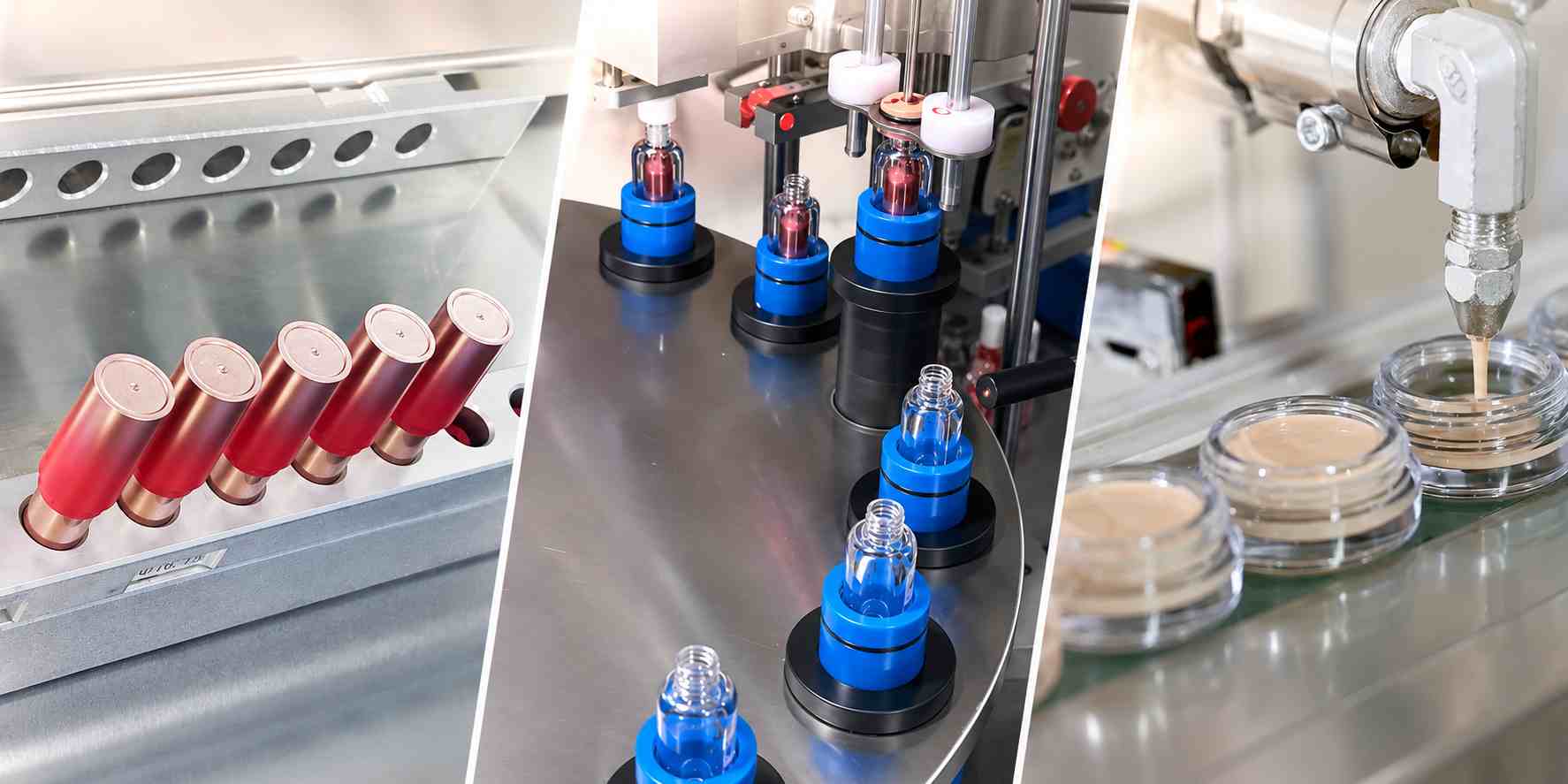
Cosmetic filling and packaging is not one universal operation. A squeeze tube may be filled through its open tail and then sealed, a lipstick may be molded and inserted into its mechanism, while a pressed powder must be dosed into a pan and compressed before the pan enters the compact. The correct route follows both the formula and the package structure.
For B2B buyers, understanding these differences helps prevent a common sourcing problem: approving an attractive empty package before confirming how it will be filled, closed, cooled, pressed, or assembled. This guide explains the main routes in practical terms and identifies the information that should be confirmed before packaging and formula are locked.

Quick screening framework:
- Formula texture: fluid, viscous, creamy, wax-based, loose powder, or pressable powder.
- Filling temperature: room-temperature, warmed, or hot-pour processing according to the formula.
- Filling opening: tube tail, bottle neck, wide jar mouth, mold, pan, or cushion reservoir.
- Sealing or assembly: heat sealing, folding, pump fitting, wiper insertion, cooling, pressing, or compact assembly.
- Production target: net content, shade count, batch size, packaging orientation, and required output.
1. Start with Formula Behavior and Packaging Structure
The first decision is not the appearance of the container but the physical state of the formula. In practical cosmetics filling, four broad directions require different handling:
- Fluid liquids and emulsions: foundation, lip oil, liquid concealer, eyeliner, and other mobile formulas can be dosed through a bottle or tube neck when the opening and filling equipment are suitable.
- Viscous creams, gels, and semi-fluids: thicker lip gloss, cream products, scrubs, and masks need a filling path that allows controlled dosing without leaving excessive product around the opening or sealing area.
- Wax-based and hot-pour formulas: lipstick, lip balm, foundation sticks, and selected makeup sticks may need heating, controlled cooling, and either molding or direct filling.
- Loose and pressable powders: loose powder is dosed into a container, while pressed powder requires a pan or mold and a separate pressing stage.

General production sequence: prepare and condition the bulk, position the empty package or mold, dose the formula, complete the required sealing, cooling, pressing, or component assembly, and then inspect the finished pack. The exact steps change by format, so buyers need the complete route rather than only a nominal capacity.
2. Squeeze Tubes Are Filled Through the Open Tail and Sealed
Typical process: position the tube with its capped outlet downward and open tail upward, align the artwork where required, dose a suitable lip gloss, foundation, sunscreen, gel, or cream through the tail, then close and finish the tail. This produces the flat sealed edge seen on finished lip gloss squeeze tubes and other flexible cosmetic tubes.

- Plastic and laminated tubes: are commonly closed with a compatible heat-sealing system, followed by trimming and coding when required.
- Aluminum tubes: normally use a mechanical folding or crimping route rather than the same heat seal used for plastic tubes.
The formula must remain below the intended seal area; residue there can interfere with closure quality. Buyers should confirm tube material, formula viscosity, filling temperature, tail length, artwork orientation, coding position, and the final usable volume after sealing. The exact tube and seal combination should be reviewed with the selected cosmetic tube packaging model.
3. Wand-and-Wiper Containers Combine Filling with Component Assembly
Standard lip gloss tubes, liquid lipstick tubes, mascara tubes, liquid eyeliner containers, and selected applicator-led concealer or foundation containers are generally filled through the neck opening. The package is not complete until the wiper, stem, applicator, and cap work together with the filled formula.

Typical process: position the empty bottle or tube, dose the formula through the neck, install the wiper at the stage required by the selected line, and close the pack with its stem, applicator, and cap. The exact assembly order can vary with the component design. The important buyer checks are:
- Filling access: the neck opening must suit the filling nozzle and target formula.
- Headspace: the fill level must leave room for the wiper, stem, and applicator without causing overflow.
- Pickup control: formula viscosity, wiper opening, stem, and applicator determine how much product is withdrawn.
Final closure: cap thread, stem alignment, sealing surfaces, and opening force need to remain stable after filling.
A nominally compatible bottle and brush are not enough. Filled testing must confirm dosing, insertion, withdrawal, wiping, application, and closure as one component set.
4. Foundation Bottles and Pump Systems Use the Bottle Neck as the Main Filling Route
Typical process: feed and position the empty bottle, dose the liquid foundation or emulsion through the neck, fit the pump or required inner component, then close and inspect the assembled bottle. The production route depends on the opening, formula viscosity, required net content, and the way the pump or closure connects to the package.
For buyers comparing makeup foundation containers, the main questions are straightforward: Can the formula pass through the intended filling system? Is there enough headspace for the pump? Does the selected pump provide an appropriate output? Does the neck finish match the pump and cap?
After assembly, selected filled samples should be checked for pump priming, consistent output, closure fit, and formula residue around the neck. These checks help confirm that the selected pump bottle works with both the formula and the planned production route.
5. Jars Provide a Wide Opening for Balms, Masks, Scrubs, and Creams
A wide-mouth cosmetic jar provides direct top access for filling lip masks, lip balms, lip scrubs, cream products, gels, and other suitable formulas. This simple opening is useful for viscous products that would be difficult to move through a narrow neck, but the filling condition still needs to follow the formula.
Typical process: position the open jar, dose the formula from the top, allow settling or controlled cooling when required, clean the rim, then add the applicable liner, inner cover, seal, applicator, and outer lid.

- Room-temperature filling: may suit formulas that already flow or dose correctly without additional heat.
- Warm or hot filling: may be required for wax-based or heat-processed formulas, followed by controlled cooling before final closure.
 Target fill weight, visible fill line, headspace, cooling shrinkage, jar cleanliness, lid fit, and formula contact with any liner or inner cover should be checked on the actual package. A clear jar also makes uneven surfaces, air pockets, and fill-height variation more visible.
6. Lipstick and Makeup Sticks Require Different Filling Routes
Solid and semi-solid sticks should not be treated as one filling category. The typical process depends on the route: a molded bullet is formed outside the final mechanism and inserted after cooling, while a direct-filled product is dosed into a suitable cup or component and cooled in place.
- Molded lipstick bullets: the heated bulk is dosed into a mold, cooled until the bullet holds its form, released from the mold, and inserted into the lipstick packaging mechanism. Bullet shape, surface quality, hardness, shrinkage, and fit with the cup all matter.

- Direct-filled sticks: selected lip balms, foundation sticks, and other makeup sticks can be filled into a suitable component or cup and then cooled. This route requires enough heat resistance, controlled fill height, and a mechanism that remains clean and operable.

- Paper push-up and special stick formats: need individual review of the inner contact surface, formula hardness, filling temperature, cooling behavior, and the force required to advance the product.
When selecting cosmetic stick packaging, buyers should provide the formula direction or a bullet sample rather than assuming the same tube can accept every hot-pour product.
7. Loose Powder and Pressed Powder Use Different Production Processes
The distinction between loose and pressed powder is fundamental because only one route ends with freely moving powder inside the final container.
- Loose powder process: position the jar, dose powder by weight or volume, remove powder from the rim and assembly area, then install the sifter or fixed-hole insert, inner cover, puff, and lid required by the chosen loose powder container. Powder flow, dust control, fill weight, headspace, insert depth, and pickup are the main checks.
- Pressed powder process: dose prepared powder into a pan or compatible mold, press it under controlled conditions, remove loose surface powder, inspect the cake, and install the finished pan in a powder compact case or palette. Formula behavior, binder level, dose, pan dimensions, pressing conditions, surface design, and final payoff need to work together.

A compact case does not determine the pressing result by itself. The powder formula and pan are part of the production system, while the compact protects, presents, and supports the finished pan.
8. Cushion Compacts Need a Compatible Formula and Reservoir Route
Typical process: depending on the selected system, dose the compatible formula into the reservoir or through the sponge-loading route, allow it to distribute, then assemble the inner closure, puff, and empty cushion compact. The formula needs controlled mobility so it provides usable pickup without migrating excessively around the case.
Buyers should confirm target fill quantity, reservoir compatibility, impregnation or distribution, puff pickup, inner-lid closure, drying around contact areas, and the appearance after the compact has been stored. Cushion structures vary, so the exact filling and assembly route should follow the selected insert and case rather than a general assumption about all cushion products.
9. Compare the Main Filling and Assembly Routes
| Product format | Filling entry | Closing or assembly | Priority checks |
|---|---|---|---|
| Squeeze tube | Open tail | Heat seal or fold | Material, formula, seal area |
| Wand container | Neck opening | Wiper, stem, applicator cap | Viscosity, pickup, headspace |
| Pump bottle | Bottle neck | Pump and cap | Output, neck fit, closure |
| Jar | Wide top opening | Inner part and lid | Temperature, fill height, cooling |
| Lipstick or stick | Mold or component | Cooling and assembly | Hardness, shrinkage, mechanism |
| Loose powder | Jar opening | Sifter and lid | Flow, weight, dust control |
| Pressed powder | Pan or mold | Press and compact assembly | Pan, dose, powder behavior |
| Cushion compact | Reservoir system | Inner lid, puff, case | Distribution, pickup, closure |
10. When Brands Need Contract Cosmetic Filling Support
Brands may purchase empty packaging only, provide an approved formula for filling and packing, or use an integrated route that combines formula development, package matching, filling, assembly, and final packing. The suitable level of outsourced production support depends on which parts of the project are already confirmed.

Typical project process: confirm the formula and packaging route, review the required filling and assembly setup, complete trial filling with the actual components, approve the result, then move into bulk filling, assembly, inspection, and packing.
Before requesting a quotation, provide:
- product category and formula type;
- viscosity, filling temperature, and any known processing requirements;
- target net weight or volume;
- selected packaging model or intended packaging structure;
- shade and SKU count;
- order quantity, target market, and delivery schedule.
KAIYA supports packaging-only orders as well as formula, filling, assembly, and packing projects. Our automatic and semi-automatic cosmetic bottling line options are matched to the product and package rather than treated as one fixed route. By coordinating formula behavior, package structure, trial filling, component assembly, and production requirements, KAIYA helps brands move from an empty container to a practical cosmetic filling and packaging plan.