Lipstick and other cosmetic sticks cannot be matched to packaging by diameter and appearance alone. The formula may be formed in a separate mold, filled through the top of the final component, or introduced through a rear opening while the component is inverted. Each route changes which packaging parts contact the formula and how the stick is cooled, supported, and assembled.
For B2B buyers, the key question is where the formula takes shape and how the selected package participates in that process. This guide separates mold filling, direct top filling, and back filling so brands can evaluate lipstick packaging and cosmetic stick packaging against the intended production route.

Quick screening framework:
- Formula state: the temperature, viscosity, and hardness direction during filling and after cooling.
- Forming route: separate mold, direct top filling, or back filling into the final component.
- Filling entry: top opening, rear opening, mold cavity, or another structure-specific route.
- Supporting component: cup, platform, inner wall, base opening, and temporary seal.
- Finished function: bullet stability, rotation, retraction, cap clearance, and surface condition.
1. Start with Where the Stick Is Formed and Filled
The first distinction is whether the formula becomes a finished stick outside or inside the final package. When it forms inside the package, the direction of filling also matters.
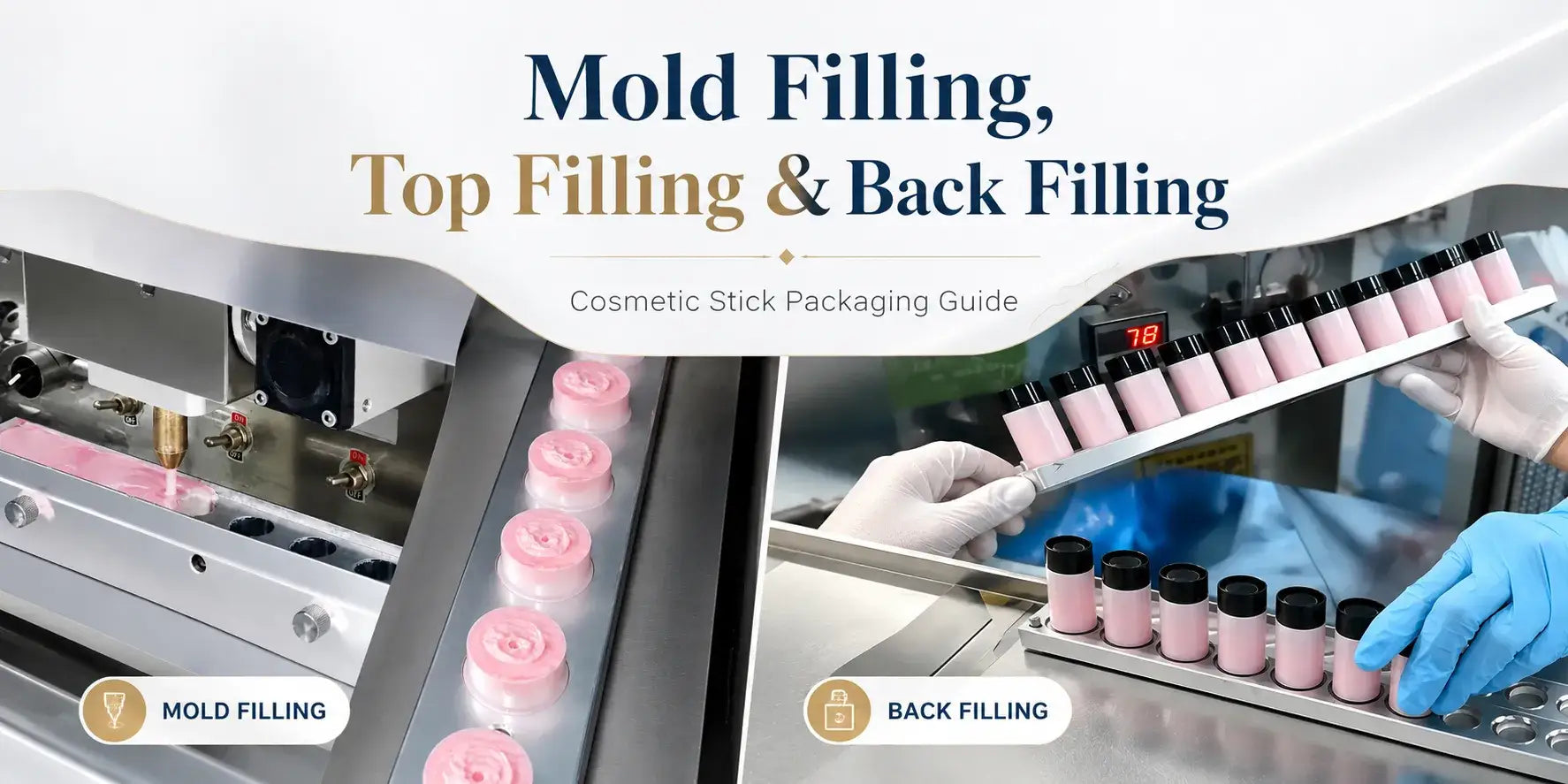
- Mold filling: the heated, pourable formula is dosed into a separate mold, cooled until it holds its shape, removed from the mold, and inserted into the package mechanism.
- Direct top filling: the final component remains upright while the formula is dosed through its top opening and cools inside the selected cup or cavity.
- Back filling: the final component is normally inverted and filled through a rear or base opening before cooling and completion of the remaining closure or assembly.
Top filling and back filling are both direct-to-component routes, but they should not be treated as identical. The filling entry, package orientation, visible finished surface, temporary closure, and assembly sequence can differ.
2. Mold Filling Forms the Bullet Before Final Assembly
In a typical mold-filling route, the bulk is heated until it reaches the required pouring condition and is dosed into metal, silicone, or another suitable mold system. After controlled cooling, the formed bullet is released and transferred into the lipstick cup or stick mechanism.
Mold filling forms the cosmetic stick separately before cooling, demolding, and final package assembly.
This route is commonly associated with traditional lipstick bullets and selected slim or shaped sticks because the mold defines the outside profile. It can support controlled tip geometry and a smooth molded surface, but the result still depends on the formula, mold condition, cooling curve, release method, and handling during insertion. A mold should not be described as guaranteeing that every bullet has no visible line or surface variation.

The package is mainly evaluated after the bullet has formed:
- Cup fit: the bullet base must enter and remain supported without excessive insertion force.
- Bullet alignment: the formula should rise through the package without leaning into the inner wall or cap.
- Mechanism movement: insertion should not deform the cup or interfere with raising and retracting.
- Cap clearance: the selected bullet height and tip shape need enough space inside the closed package.
3. Direct Top Filling Uses the Final Component as the Cooling Cavity
In direct top filling, the package or inner component is kept upright and the pourable formula enters through the open top. It cools and sets inside the final cup, platform, jar, or stick cavity instead of being demolded and transferred later.
This route can remove the separate demolding and bullet-insertion stages, but the final component must contain the formula during filling and remain stable through cooling. The upper surface is also formed at the filling side, so fill level, trapped air, cooling shrinkage, and surface recession may be more visible in the finished product.
Buyers should confirm:
- Top opening: whether its diameter provides practical filling access without contaminating the surrounding package.
- Fill level: how much clearance is needed for cooling, later assembly, and cap protection.
- Internal support: how the set formula anchors to the cup, platform, or cavity during use.
- Cooling result: whether the top surface remains level and whether shrinkage creates a gap or recessed center.
- Assembly order: which cap, insert, tool, or upper component is added after filling and cooling.
4. Back Filling Uses a Rear Opening and an Inverted Component
Back filling is another direct-to-component route, but the package or inner component is commonly positioned upside down and filled through an open base or rear entry. The formula cools inside the selected cavity before the rear opening is closed or the remaining base assembly is completed.
Back filling places the pourable formula into an inverted component so it can cool and set inside the selected package.
The inverted position changes what needs to be controlled. The upper part of the cavity helps define the front of the finished stick, while the rear entry needs to contain the formula and be completed without disturbing the set product. The exact opening, temporary seal, plug, and final assembly depend on the selected package and production equipment.

Buyers should confirm:
- Rear entry: where the formula enters and how that opening is closed or completed afterward.
- Thermal exposure: which components contact the heated bulk and whether fit or movement changes after cooling.
- Inverted support: how the component is held so the formula sets at the intended level and orientation.
- Front profile: which internal surface defines the visible end of the stick and how cleanly it releases when opened for use.
- Base completion: whether a plug, cover, platform, or another component is installed after cooling.
5. Compare Mold Filling, Direct Top Filling, and Back Filling
| Route | Where the stick forms | Packaging exposure | Priority checks |
|---|---|---|---|
| Mold filling | Inside a separate mold | Final mechanism is typically assembled after the bullet cools | Mold release, bullet strength, cup fit, insertion, alignment |
| Direct top filling | Inside the final cup or package component | Package remains upright and formula enters through the top | Opening access, fill level, anchoring, top-surface shrinkage |
| Back filling | Inside the final component while inverted | Formula enters through a rear or base opening | Rear seal, inverted support, front profile, base completion |
The table provides a route-level comparison, not a universal formula rule. The selected product may need a variation of these steps according to its formula, diameter, component structure, equipment, and production quantity.
6. The Filling Route Changes Which Packaging Details Matter Most
- Inner cup or platform: a molded bullet needs secure insertion and grip, while a direct-filled stick needs a component that can contain and anchor the formula as it sets.
- Mechanism tolerance: the elevator should raise and retract smoothly after bullet insertion or after direct exposure to filling and cooling.
- Material response: components involved in direct filling need to retain their dimensions through the actual thermal cycle.
- Base and temporary closure: a back-filled design needs a controlled filling entry and a practical method for completing the component afterward.
- Cap and inner clearance: the finished stick height, tip, possible shrinkage, and movement during transport should not cause contact damage.
- Decoration and assembly order: coating, printing, or metallic finishes may be completed before or after selected production stages, so appearance should be reviewed on a production-representative sample.
These questions become especially important when a brand changes formula hardness, stick diameter, filling factory, or mechanism while trying to preserve the same external package.
7. Different Production Routes Create Different Failure Patterns
A surface defect does not always indicate a packaging problem, and a mechanism problem does not always come from the formula. The production route helps narrow the investigation:
- Mold-filling concerns: incomplete mold filling, trapped air, release marks, bullet cracking during demolding, damage during insertion, or poor grip between the bullet and cup.
- Direct-top-filling concerns: contamination around the opening, trapped air, an uneven fill level, a recessed top surface, formula pulling away from the wall, or weak anchoring.
- Back-filling concerns: leakage from the rear entry before setting, movement during inverted cooling, an incomplete base closure, poor front-profile formation, or formula damage during final assembly.
- Shared concerns: leaning, cap contact, poor retraction, excessive movement, surface damage during transport, or a formula that becomes too soft under the expected storage conditions.
The useful response is to identify the stage where the defect first appears. Changing the outer package without checking the mold, filling temperature, cooling support, insertion, or formula behavior may leave the real cause unresolved.
8. Approve the Package with the Intended Production Route
An empty mechanism can confirm basic rotation and cap fit, but it cannot prove that the complete stick will perform after filling. A more useful approval sequence is:
- Confirm the formula direction, stick diameter, target weight, tip shape, and mold, top-fill, or back-fill route.
- Select the cup, mechanism, cap depth, filling entry, and required temporary closure.
- Run a small production-representative filling, molding, cooling, and assembly trial.
- Review surface appearance, shrinkage, anchoring, alignment, rotation, retraction, and cap clearance.
- Record the approved formula, component set, route, orientation, and finished sample before bulk production.
This is more reliable than approving the formula and empty package separately and expecting them to combine without further adjustment.
9. Develop Cosmetic Stick Packaging Around the Real Filling Process
KAIYA supplies lipstick tubes and cosmetic stick packaging for lip balm, foundation, blush, contour, highlighter, sunscreen, and other suitable solid or balm-like formulas. We can help buyers compare existing components and custom directions against the intended mold-filling, direct-filling, or back-filling route, then review the cup, mechanism, cap, shape, color, and finish as one package.
Share the formula direction, working filling condition, forming route, stick diameter, target weight, filling location, package concept, order quantity, and launch schedule. KAIYA can use this information to recommend a more practical sample route and reduce mismatches between the packaging design and final production process.